Showing posts with label furniture. Show all posts

8.19.2008

Sushi Table doubles as a Coffee Table

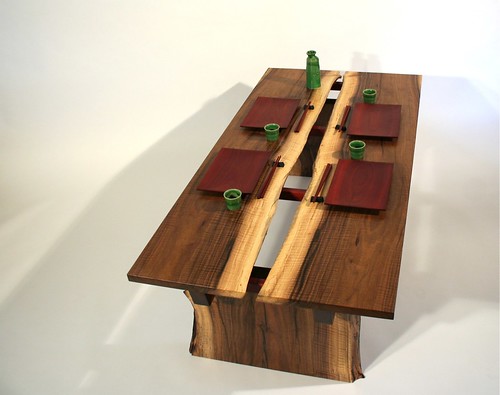
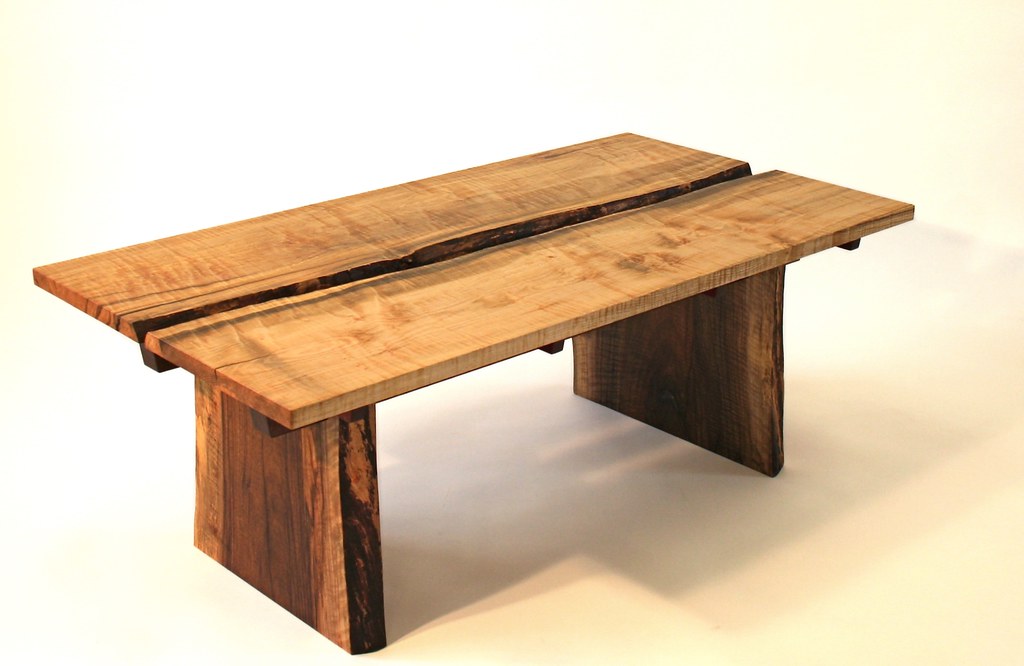
My live-edge walnut and bloodwood sushi table will be one of two of my pieces featured in the Western Design Conference in Jackson Wyoming. The conference takes place September 3 through 6th. Open to the public September 4th - 6th. Please come visit us at the conference!

I made this piece with the idea in mind that it could be used for Japanese-style dining (sitting on floor pillows) for four. The table includes 4 hand-carved sushi plates with chopsticks + chopstick rests as well as floor pillows and a jade-green ceramic sake set. The plates, chopsticks and rests are made by me.

Sushi Table above, © 2008 by timcarney.


or ... a "Green Tea Table:"


Thank you to anziAprico for the use of your photo


Links:


8.01.2008

Handcrafted, One-of-a-Kind Tables

See some of my handcrafted furniture (including the Sushi Table/Coffee Table displayed in the above photo) will be exhibited at the 2008 Western Design Conference in Jackson Wyoming. The public open exhibition and sale takes place from September 4 through 6th. See link for schedule and open times.

6.17.2008

Holter Museum 15th Annual Art Auction


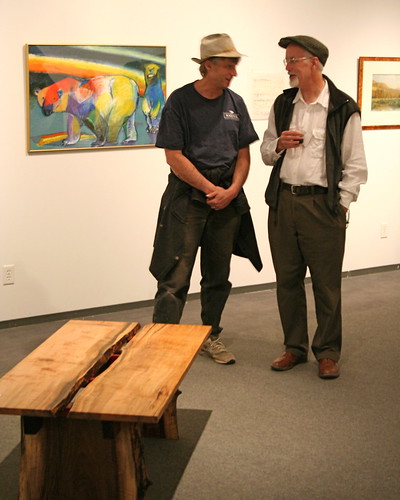
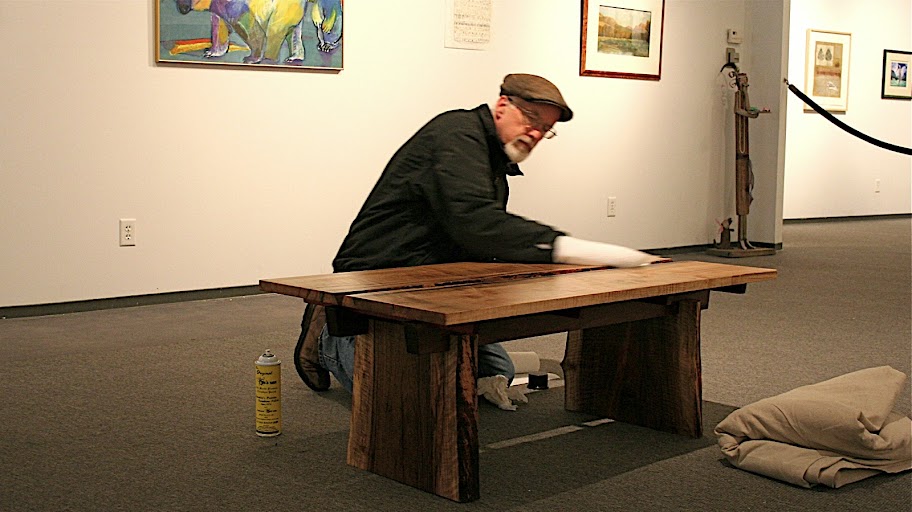
Tim donated one of his one-of-a-kind live edge tables to the Holter Museum 15th Annual Art Auction & Gala.


Prairie Coulee by Tim Carney of Helena Montana


There are many excellent works of art to be auctioned in support of the ongoing programs at the Holter, including works by Rudy Autio, Jennifer Bottomly O'Looney, Dana Boussard, Chip Clawson, Russell Chatham, Sarah Jaeger, Nan Parsons .... too many to mention all of them here. Head over to this link to see all of the works for auction.


The Auction and Gala will be from 5:30-10 p.m. on Saturday, June 28, 2008. Please come and support the arts in Helena, even if you don't plan to purchase anything at the auction. The more folks in the audience, the merrier the auction! If you don't live in Helena, but are going to be in town that evening, please consider attending the auction. It should be a fun evening.

Ticket and Gala information

5.23.2008

"Prairie Coulee" part of Holter Museum's Annual Art Auction


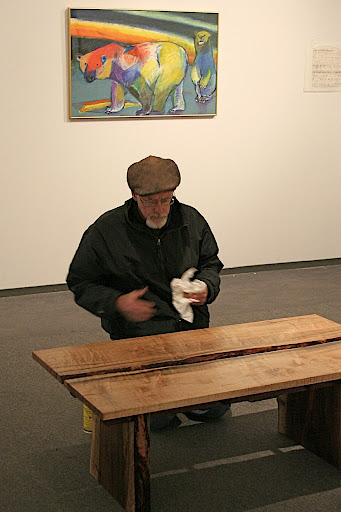
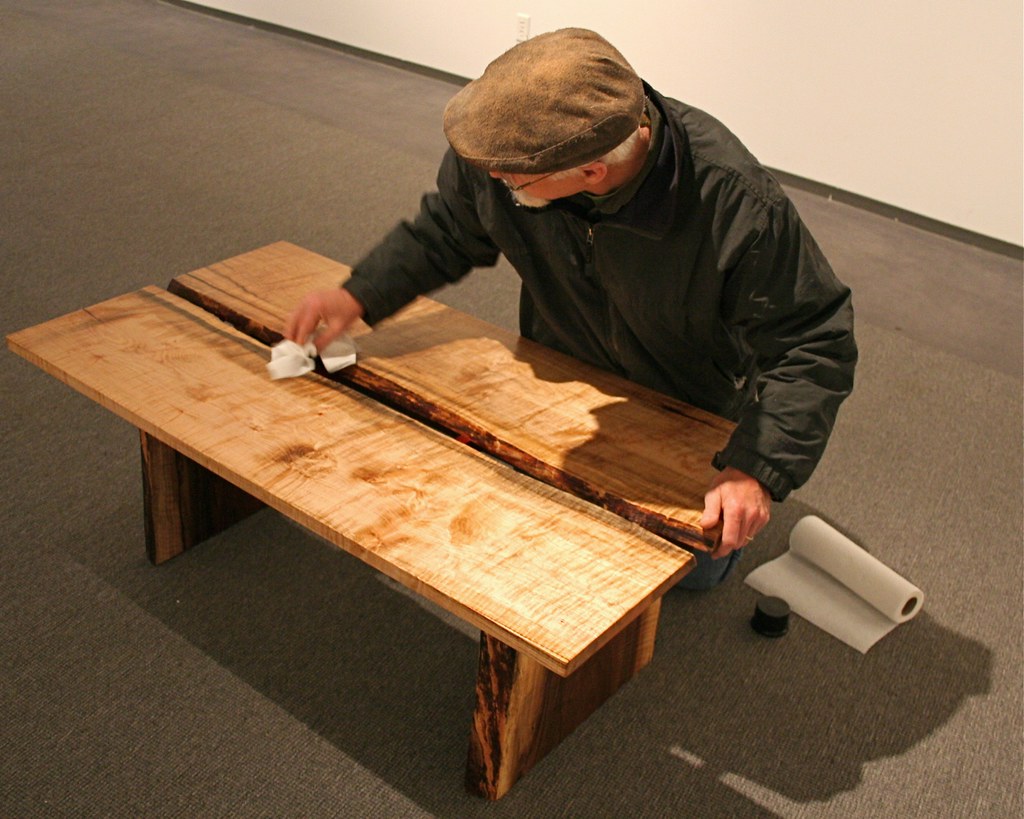
I helped Tim deliver his walnut coffee table to the Holter Museum today. He is donating this piece to the Holter's 15th Annual Art Auction fundraiser. The exhibit is still being set up, but it looks fantastic so far! I want that polar bear painting on the wall behind Tim (left.)

All auction pieces will be on exhibit from June 6th through 28th. The Gala and Auction is June 28th at the Great Northern Hotel.

Holter Museum's 15th Annual Art Auction
Bair and Millikan Galleries
June 6 - 28

Opening Reception: Fri, June 6, 6-8pm
Gala and Live Auction: Sat, June 28 at the Great Northern Hotel
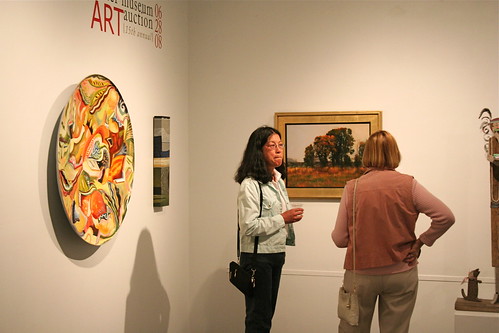
The Holter Museum presents an exciting selection from among the finest work of Montana and regional artists: ceramic vessels and sculpture, painting both figurative and abstract, works on paper, fine wood objects and furniture, hand-crafted jewelry, and mixed media. The annual benefit gala and live auction support the museum's exhibition and education programs.
"Prairie Coulee" live-edge curly maple, live-edge curly walnut and bloodwood, by Tim Carney of Helena, Montana

all photos copyright ©2008 by Maureen Shaughnessy

11.08.2007

Art of Wood

We would like to invite you to join us for an opening reception of the Helena Woodworkers' Guild 3rd Annual Exhibit, "Art of Wood." The reception is from 6 pm to 10 pm Friday, November 9th during the Downtown Helena ArtWalk. The exhibit will also be open from November 2 through 30th during box office hours at the Myrna Loy Center for the Arts at 15 East Ewing Street in Helena, Montana.

Helena is home to more fine wood artisans than most people realize. Please come see the talent and craftsmanship of our members during the month of November. Even better - join us for great food, drinks, live music and the attention of our craftsman members during the reception Friday evening.

We have 21 members of our Guild, ranging from hobbyists to experienced furniture makers. Anyone with an interest in woodworking and in learning and sharing is welcome to join our Guild.

If you live too far to visit in person, please enjoy our short slideshow below, and check back for updates on the exhibit during the month of November. (clicking on the individual photos will take you to an enlarged version)

12.15.2006

Inspiration: The Yellowstone

The Helena Woodworker's Guild recently held their annual exhibit at the Myrna Loy Center for the Arts in Helena, Montana. We put the show up on December 3 and held our opening reception on December 10th, the night of the Helena Winter Art Walk. We had pieces by John Hinshaw, Priscilla Bode, Tim Carney, Travis Smith, Chris Yavah. We had great attendance at the opening, a good time and hopefully generated lots of interest in the abilities of Helena's many talented woodworkers. We'll be posting some photos of the exhibit and opening soon.

In the meantime, I would like to introduce Tim's most recent one of a kind piece, The Yellowstone, inspired by one of North America's most awesome rivers and national parks. This hall table's live-edge slab top is made of curly mango accented with carved ripples in one end. The trestle is a sinuous fluid shape carved of lacewood and the legs' tapered laminations are of padauk and mahogany.

The Yellowstone detail

The Yellowstone


Lewis River Canyon, Yellowstone Park Photo by Hayden61

Yellowstone Park
is filled with natural wonders that have fascinated people for hundreds - or thousands - of years. Yet there are beautiful forces equally as passionate, hidden under the surface of the land. Firey reds, sulphuric yellows and vibrant turquoises are created by minerals pushed from deep under the earth's crust. In Yellowstone Gorge, you can see colors in the geological layers like paint dripping on a gigantic canvas.

And though we can see evidence of earth's geothermal activity in the paint pots, geysers and bubbling hotsprings of the park, imagine what we can't see ... the power and lifeforce under the surface.

Lacewood Detail

Although the table top itself is fine to look at, if you look beneath the live-edge slab top, even through the knot holes you can see layers of the piece. Tim carved "ripples" in the table top, where the slab's shape seemed to naturally flow like water. He chose lacewood to make a rippling trestle, because lacewood's grain also recalls the turbulence and dancing movement of rough river whitewater. Or when a trout rises to mouth the reflecting river's surface.

The legs are shaped with the thought of the volcanic activity and subsurface underneath Yellowstone Park.

The Yellowstone

Ripples Detail

12.03.2006

Exhibit

Hi Ken and Mary. I'm just gonna leave this blog post up for awhile to make it easy for you to get to Tim's flickr albums. Just click on the photo of the rocking chair (which, by the way, is the one Tim made for me - isn't he a sweetie?) Anyway, just click on the photo and it will take you to Tim's flickr page. In order to comment under any of his flickr photos, you have to sign up for a free flickr account (which is a very cool online photo storage service) ... but I think you can make comments on any of Tim's blog posts here at Shop Talk, without doing anything like registering. and don't worry - we won't spam you. [grinning]

8.26.2006

Mango & Mahogany Bed


This custom designed master bedroom set includes the mahogany and mango bed (left) with curving headboard, a curved footboard that also functions as a seat, two bedside tables and a mahogany mirror above the owner's black dresser.


There is a bookshelf neatly tucked in the most convenient place -- right up near the top of the bed. Isn't this where books and papers tend to collect anyway? Why not make an intentional place to keep your bedtime reading?

The mahogany mirror matches the bed, reflected here.
A curved footboard also functions as a seat.

3.08.2006

Want more storage without adding a new room to your home?

Whether you are building a new home or remodeling, you can never have too much storage. You could buy furniture specifically designed for storage (china cabinets, dressers) but then you would have that much more to dust and vacuum around ... and besides, you may not have room for more furniture.

Or, you could install “built-ins” which stay with the house and increase its resale value. Design as much storage as possible into your remodeling project or new home. Custom built-ins can be economical, attractive, functional and best of all, make your life easier.

Well designed built-ins can provide convenient storage in every room and contain clutter. Built-ins make small rooms seem larger and more open because they are attached to the walls and take up less floor space.

Instead of a wall between rooms, consider a partition with built-in storage and display shelves as in the photo, left. Tim and Tracy built the glass-door cases to separate the entry foyer from the living room while preserving the openness of the large room.


Custom built-ins can fit an oddly shaped corner or a closet you want to open up. Your furniture may be arranged around the focal point of a fireplace (above and left) yet you want to be able to watch movies without rearranging. Solve this dilemma with a built in media center flanking the fireplace. Combine the media cabinets with display shelves for a beautiful and functional living room focal point. The media center cabinets hide the television and any other clutter when not in use.


You’ll need plenty of built-in storage in a craft room, often located near the kitchen or in the laundry room or garage. No matter what your craft or hobby (sewing, woodworking, scrapbooking, etc) you can get customized drawer and cabinet inserts to fit your supplies and tools perfectly. Consider the benefits of being that organized!


Other possible built-ins to consider for your home are a bedroom storage wall or built-in dressers, window seat benches that double as storage with recessed bookcases on the sides, a bookcase wall with media center, mud room storage benches and wall-hung cubbies, wardrobes to organize your closets, a snack bar, wet bar or coffee bar in the family room, a dining booth and a built-in desk near the kitchen (left,) a craft room storage wall with workbench, drawers and display cases, bookshelves under the stairway, dining room wall hutch or display niches for art, recessed between wall studs.

This custom built dining room hutch (left) by Timothy's Fine Woodworking, leaves plenty of room to expand the table for large dinner parties. The hutch has in-cabinet lights to highlight the china collection as well as lots of practical storage.

There are almost endless possibilities for making more effective use of the space in your home by adding built-ins. Take advantage of the numerous cabinetmakers and woodworkers in your city or town, who can customize your home with built-in furniture, storage cabinets and display shelves. To find a woodworker who can work with you on custom built-ins, start with your local phone directory listings under “Cabinets” or “Furniture Designers & Custom Builders.”

Tim J Carney

3.06.2006

Why build a prototype?


(by the way, if you want to see any of the photos on this site enlarged, just click on them)

When I design and create a custom piece of furniture such as this dining chair, I have several steps. After initial concept sketches, I draw the piece to scale. My second step is to use the scaled drawing to make a prototype -- or full-scale model -- of the chair. With the prototype I can test-drive the piece to make sure it is comfortable, sized correctly and most importantly, to refine the lines and forms of the design. The third step is building the actual chair. I guess there is a fourth step: making sure my customers are satisfied!

The photo above is the first version of the prototype for an armless dining chair. After contemplating the model for a day, taking it home and letting Maureen sit in it and give me her opinion, I decided to make a few changes to the chair. I change the prototype to make sure I am 100% satisfied before gluing up and cutting the walnut and curly maple I will use for the final piece.

As you can see, the prototype is very rough -- for instance, the joints are not faired the way they will be in the final chair. I don't use glue for the prototype - the joints are mechanical or fitted with screws. This makes it easy for me to take the model apart to make adjustments.


Dining Chair Sketch
Originally uploaded by timcarney.
Although I was planning to fair out the chair legs anyway, I noticed from the prototype that I wanted to make the legs and seat of the chair more graceful, slightly more curved and rounded out than I had originally drawn in my sketch. I also immediately knew that I wanted the crest rail to have a more pronounced curve and that the balance between the hard lines and soft lines of the chair needed some tweaking. The joints of a prototype are extremely rough -- I leave extra wood at the joints on the model. But having this new design sitting in front of me -- in three dimensions made it a lot easier for me to see where I needed to make the transition points between hard and soft, and around the joints, have a more graceful flow.

All of the changes I thought of making after seeing and trying out the prototype are subtle changes, but it's those subtle, almost invisible qualities of a piece of custom furniture that make the difference between a hohum or unattractive piece and a piece that really has soul, a beautiful well-crafted piece of furniture.

I make prototypes whenever I am working on a piece of furniture that's totally new to me. The extra time it takes me to build a full size model is well worth it in the end results.

This (photo above) is the first go-round of refinements to the chair model. I'll post more pictures of our refinements, and the finished chair as the work progresses. Thanks for stopping by my website and we'd sure appreciate it if you want to leave a comment, feedback, or ask any questions.

-- Tim J. Carney


(my editor insisted on putting this pile in, just for fun.)
More views of the refined prototype:


2.01.2006

Transforming Flaws to a Thing of Beauty


Memorial Table2
Originally uploaded by timcarney.
Saint Paul's Church in Helena has recently dedicated their new church home after many years of work and fundraising for this ambitious building project. Years ago I served on the building planning committee, when we had to make the difficult decision to cut down the old birch tree near Susanna's Place because it was in the way. We could have sited the church building a little differently, or designed it to fit around the birch, but we knew the tree was diseased and dying anyway ... it's life was close to an end and we'd be damaging the root zone so much that the weakened tree would not survive construction.

The birch was infested with birch borers -- beetles and larvae. These are the same insects that are killing birch trees all over Helena and other parts of the west. When a birch or aspen is infected with borers, the tree starts dying from the top down and many people don't notice their beautiful trees are slowly dying because they don't look at the top branches. By the time we notice the problem, it's often too late to save the tree. The borers are always present in our ecosystem. But when trees such as birch or aspen are stressed by many years of drought, they cannot flush out the borer larvae with a healthy flow of sap. That allows the borers to set up housekeeping and do their damage to the trees. Montana has had 8 years of severe drought. Our town's birch trees are in grave danger unless we get more rain or water them adequately.

I write this to give you some background into why the old birch was removed when church construction began. Many church members were saddened by it's demise. The decision to cut the birch was made easier when we thought of planking up the wood from the tree and using it in the new church building. Tim Carney has had the birch wood drying and aging in his shop for about two years. He recently finished making a beautiful table for St. Paul's which will be used to hold the book of memorials in the new lobby.


Have you ever heard of the idea of the Wounded Healer?" Who would you turn to in a time of crisis when you need true empathy? I turn to those I know have experienced something like what I am faced with. Someone who has grappled with -- and survived -- the difficulties of life. Someone who is, who has been, wounded themselves. Wounded by cancer, aids, depression, alcoholism, societal prejudice, a broken heart or the loss of a loved one. A therapist who has suffered from depression knows the way depression feels -- and not just from book learning. A healer who has suffered from crippling arthritis might have the greatest empathy for a patient's struggle with pain. Recovering alcoholics are often the best folks to come to the aid of fellow alcoholics. They know the game. They know the wounds. Someone who has lost a child may be able to give the greatest comfort to parents of a stillborn baby.

So what does this have to do with a birch tree and a table?

As he worked on the table, Tim realized that he was working not only with wood planks, but also with the spirit of the diseased birch tree ... and he intuitively used a poetic metaphor of how being wounded, being frail, being damaged and making mistakes can make us beautiful. And strong. It's not the only way to transform yourself -- but it is one way.


Birch table with floating top
Originally uploaded by timcarney.
At first glance, the wood planks appeared ordinary, nothing to write home about. In fact, the wood was punky and full of rot. Tim wasn't even sure he could salvage enough from the entire tree to make one small table. One night he came home from the shop full of excitement telling me the wood turned out to be beautiful -- and it was most beautiful where the tree had been "hurt" by the insects and fungus. He chose the birch planks with care, noticing where the tree had been tunneled by borers. In those weak spots, fungus had invaded, giving the wood grain a rich, dark gleam. If not for the damage, these birch wood planks would be unremarkable.

Tim had found a way to create something of great beauty from an old tree's wounds and "ugly" parts. If we don't die from our illnesses ... we are often made stronger ... and in some ways, more beautiful. We come back to our lives and our communities filled with a renewed sense of the preciousness of life. Our spirits have more depth, more dimension. We have gone through the fire, through sickness and trouble ... we have come through to the other side where our wholeness contains our wounds, our "ugly" parts, our shadow selves.

Once there was a venerable birch tree that caused much agony when a community had to choose: whether to save it or cut it. This old tree has come full circle and is back "home" with a message of hope, beauty and acceptance. It will stand in the church lobby supporting the names of those who have died, along with the names of those left behind. Like the wounded tree transformed by love and skill and vision into an object of usefulness and beauty, our own flaws can be transformed into empathy and compassion and solidarity.

written by Maureen Shaughnessy