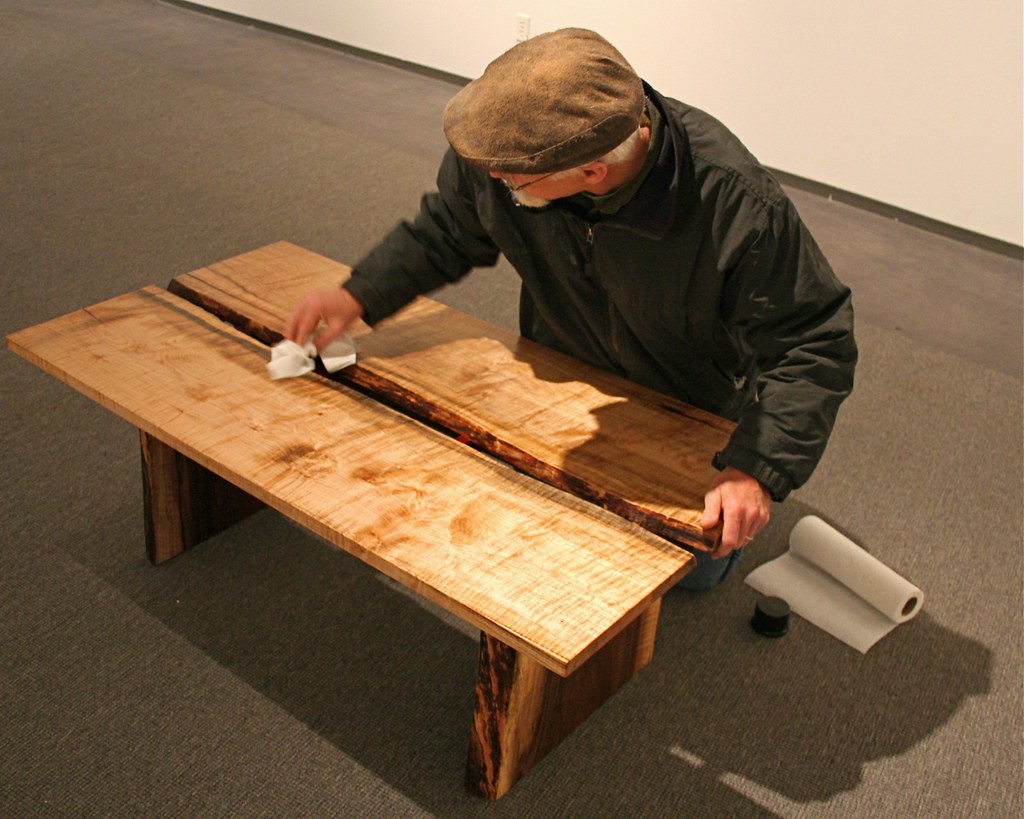
We met Lou and Cheryl Quallenberg at the Western Design Conference and immediately hit it off with both of them. Personally I like this photo I shot of Lou better than the pics he has on his website. (heh -- tongue planted firmly in cheek -- heh.) Lou really does have a fun sense of humor: enough anyway, to match Tim's.
Lou creates exquisite tables, benches and desks from large slabs of mesquite that might otherwise be doomed to the barbecue pits of Texas. Cheryl is an artist and graphic designer in her own right, creating colorful impressionist watercolours and promoting Lou's woodworking with her clean, elegant graphic design.
I only got a hint of the many excellent stories these two have to share ... I hope we see them at next year's WDC -- even better, maybe they'll show up in Helena for a relaxed visit.
(lou-and-cheryl: hint, hint) -- Maureen
p.s. check out Lou's furniture at Lou Quallenberg Studios
9.08.2008
New Friends from the Western Design Conference

9.06.2008
Contemporary, Traditional, Creative, Western, Organic, Wild ... how we experienced the Western Design Conference
Welllp ... the Western Design Conference 2008 is over -- done -- fini -- and boy are we tired! Tim and I haven't had to stand on our feet for that many days and hours in a long time.
Tired, yes ... but good-tired. Just moments after we finished loading the truck and saying goodbye to the many wonderful folks we met at WDC, I snapped this shot our hotel:
Later in the week, I will post more about the conference: photos and observations of the conference as a whole, as well as some I snapped of some of the new friends we met here in Jackson, Wyoming. More than anything else, I appreciated meeting some of the amazing artists and craftspeople in the west. Check back in a couple of days when Tim and I have a chance to decompress and maybe I'll have a photo of you and your artwork here on ShopTalk. -- Maureen
9.01.2008
Western Design Conference: September 2008

We are heading off tomorrow for the Western Design Conference in Jackson, Wyoming. I am looking forward to finding new venues for my handcrafted furniture, through meeting folks at the Jackson gathering.
Thank you to my wife and family, friends and customers for your support and the opportunity to practice my art and bring satisfaction and enjoyment to you for years to come. Maybe I'll see some of my customers and readers at the conference
8.19.2008
Sushi Table doubles as a Coffee Table
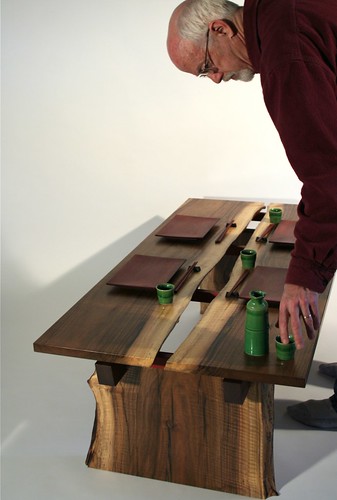
My live-edge walnut and bloodwood sushi table will be one of two of my pieces featured in the Western Design Conference in Jackson Wyoming. The conference takes place September 3 through 6th. Open to the public September 4th - 6th. Please come visit us at the conference!
I made this piece with the idea in mind that it could be used for Japanese-style dining (sitting on floor pillows) for four. The table includes 4 hand-carved sushi plates with chopsticks + chopstick rests as well as floor pillows and a jade-green ceramic sake set. The plates, chopsticks and rests are made by me.
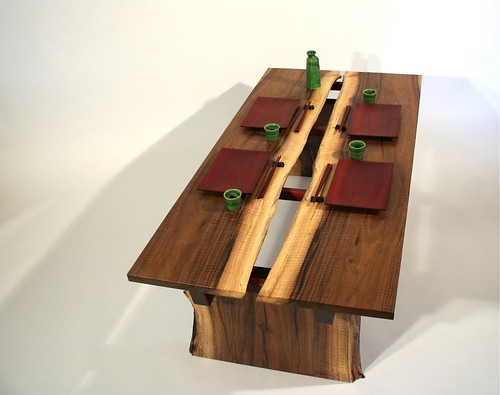
Sushi Table above, © 2008 by timcarney.
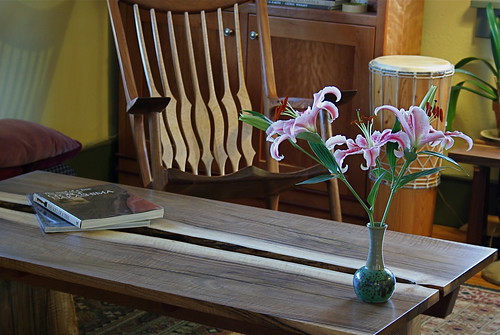
or ... a "Green Tea Table:"
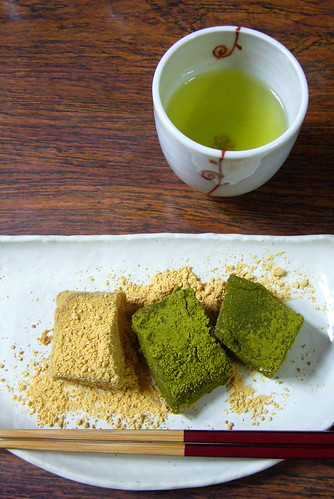
Thank you to anziAprico for the use of your photo
Links:
8.01.2008
Handcrafted, One-of-a-Kind Tables

7.01.2008
6.17.2008
Holter Museum 15th Annual Art Auction

Tim donated one of his one-of-a-kind live edge tables to the Holter Museum 15th Annual Art Auction & Gala.
Prairie Coulee by Tim Carney of Helena Montana
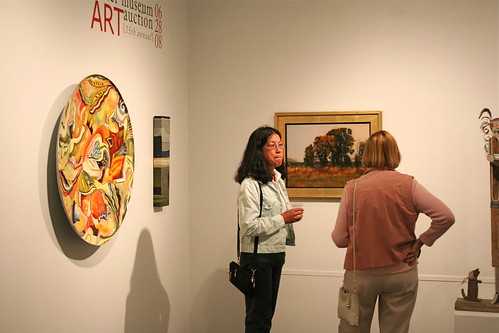 There are many excellent works of art to be auctioned in support of the ongoing programs at the Holter, including works by Rudy Autio, Jennifer Bottomly O'Looney, Dana Boussard, Chip Clawson, Russell Chatham, Sarah Jaeger, Nan Parsons .... too many to mention all of them here. Head over to this link to see all of the works for auction.
The Auction and Gala will be from 5:30-10 p.m. on Saturday, June 28, 2008. Please come and support the arts in Helena, even if you don't plan to purchase anything at the auction. The more folks in the audience, the merrier the auction! If you don't live in Helena, but are going to be in town that evening, please consider attending the auction. It should be a fun evening.
Ticket and Gala information
5.23.2008
"Prairie Coulee" part of Holter Museum's Annual Art Auction
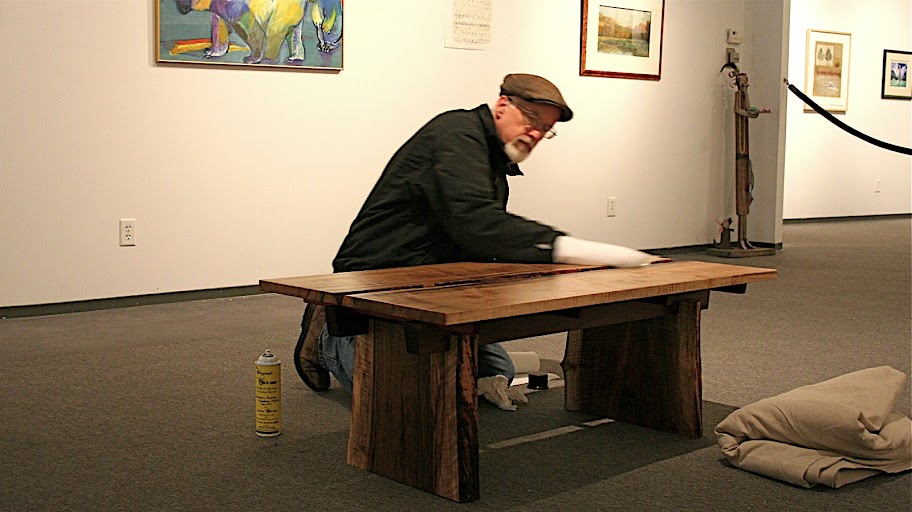
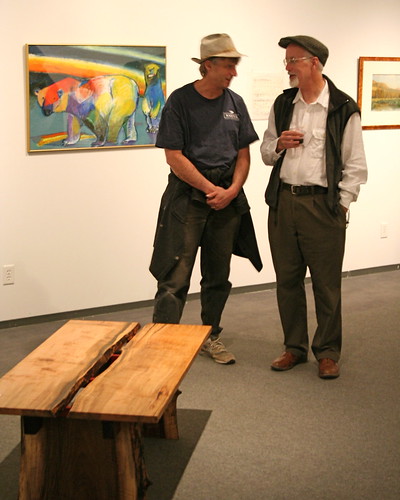
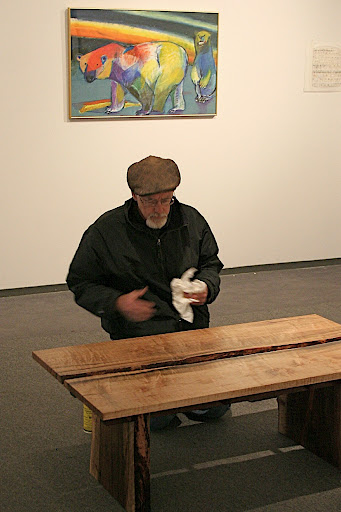 I helped Tim deliver his walnut coffee table to the Holter Museum today. He is donating this piece to the Holter's 15th Annual Art Auction fundraiser. The exhibit is still being set up, but it looks fantastic so far! I want that polar bear painting on the wall behind Tim (left.)
All auction pieces will be on exhibit from June 6th through 28th. The Gala and Auction is June 28th at the Great Northern Hotel.
Holter Museum's 15th Annual Art Auction
Bair and Millikan Galleries
June 6 - 28
Opening Reception: Fri, June 6, 6-8pm
Gala and Live Auction: Sat, June 28 at the Great Northern Hotel
The Holter Museum presents an exciting selection from among the finest work of Montana and regional artists: ceramic vessels and sculpture, painting both figurative and abstract, works on paper, fine wood objects and furniture, hand-crafted jewelry, and mixed media. The annual benefit gala and live auction support the museum's exhibition and education programs.
"Prairie Coulee" live-edge curly maple, live-edge curly walnut and bloodwood, by Tim Carney of Helena, Montana
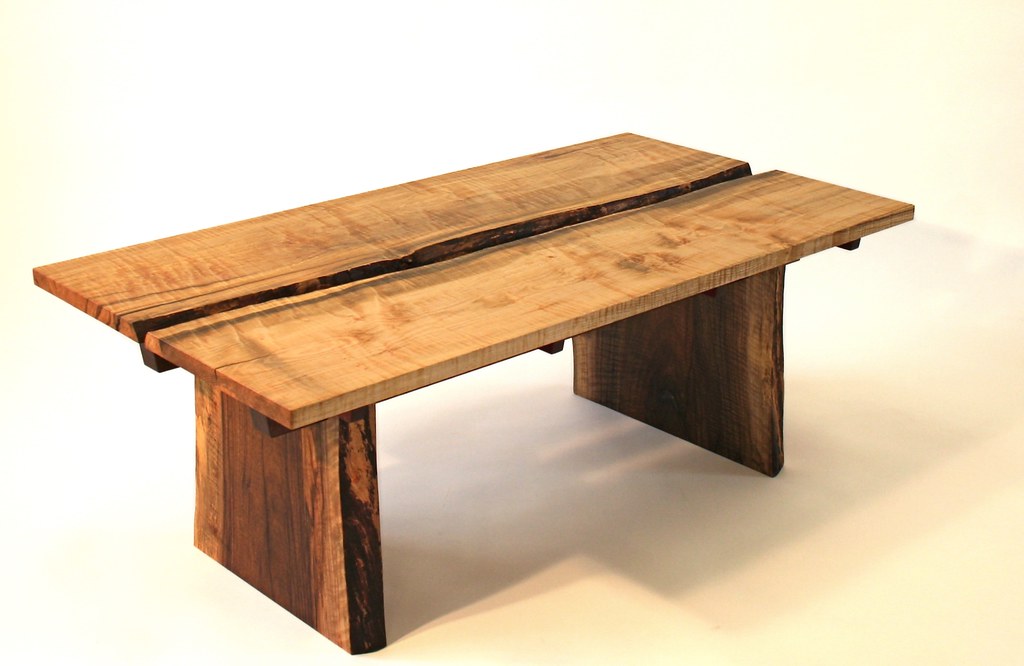
all photos copyright ©2008 by Maureen Shaughnessy

4.21.2008
Timothy's Furniture represented by Legends, of Whitefish Montana
Tim and I recently spent a pleasant two days in Whitefish, Montana delivering 6 studio furniture pieces to Legends Fine Wood Furnishings at Stampede Square.
We unloaded the furniture in the late afternoon, then headed over to the Duck Inn where we stayed the night. I had made the reservation through Duck Inn's website, so I wasn't sure how the real thing would measure up to the photos. We were both extremely happy with the room: we had a view of Whitefish River, elegant bed linens and good inn-keeper company.
We shared a fabulous dinner at Tupelo Grille which specializes in Creole and Cajun dishes. As of that night, Tupelo's Grill replaced Chico Hot Springs Restaurant in my mind, as the best restaurant food to be had in Montana. An excellent red cuvee: Marquis-Philips "Sarah's Blend" wine and delicious appetizers filled us with just enough room to have their reknowned bread pudding with rum sauce. OMG! I now have a new favorite dessert. Yumm!
Enough about the food (though I could go on about the yummy breakfast at the Buffalo Cafe next morning ...)
After spending the next morning at Legends gallery with owner Cindy Goodwin, and taking lots of photos of Tim's furniture in place (most of which did not turn out -- I'm really not a decent interior photog) we headed over to the woodshop of another woodworker represented by Legends, Phillip Pontillo. He was building this cabinet when we visited.

We spent a pleasant hour visiting with Phillip in his small (750 square foot) Whitefish shop. Phillip builds beautifully crafted studio furniture which can be seen at Legends. We were amazed at how much Phillip packs into his small space, and thought his shop deserves some press.
Speaking of shops and efficient use of shop-space, you might want to check out this woodworking shop, 700 square feet of efficient space for one woodworker, Matthew Teague. The link (above) is the "Final Walk-Through" post on Teague's blog, Smart Shop which is one of the Fine Woodworking sponsored blogs.
11.08.2007
Art of Wood
We would like to invite you to join us for an opening reception of the Helena Woodworkers' Guild 3rd Annual Exhibit, "Art of Wood." The reception is from 6 pm to 10 pm Friday, November 9th during the Downtown Helena ArtWalk. The exhibit will also be open from November 2 through 30th during box office hours at the Myrna Loy Center for the Arts at 15 East Ewing Street in Helena, Montana.
Helena is home to more fine wood artisans than most people realize. Please come see the talent and craftsmanship of our members during the month of November. Even better - join us for great food, drinks, live music and the attention of our craftsman members during the reception Friday evening.
We have 21 members of our Guild, ranging from hobbyists to experienced furniture makers. Anyone with an interest in woodworking and in learning and sharing is welcome to join our Guild.
If you live too far to visit in person, please enjoy our short slideshow below, and check back for updates on the exhibit during the month of November. (clicking on the individual photos will take you to an enlarged version)
8.29.2007
Fantasy Tree: the Baobab

Anyway, Nakashima writes that, "although baobabs are huge, sometimes reaching almost a hundred feet in girth, their ages are obscure, for they do not have annual rings like most trees." Hmmm .... wonder how scientists do calculate the age of these trees? Nakashima mentions a baobab said to be over four thousand (!) years old.
Here is another of Daniel's photos of these trees -- they look like something out of Dr. Seuss's imagination:

The wood of the baobab tree can be 60 to 70 percent moisture and the tree trunks actually shrink in diameter during drought. The wood is pulpy, so I'm curious why Nakashima included the baobab in his chapter on trees used by woodworkers.
Links:
Baobab photos by Daniel Montesinos

The Soul of a Tree, by George Nakashima

Nature, Form, and Spirit: The Life and Legacy of George Nakashima
By Mira Nakashima
More about Baobab Trees
8.20.2007

4.14.2007
A Meditation on Trees: Hermann Hesse
A skilled woodworker, I believe, is one who has learned to listen to trees, who has learned a few life-lessons by working with the beautiful, strong bodies of trees and who has learned to see the soul of a tree in the roughcut slabs of wood.
The German writer, Hermann Hesse published a thoughtful collection of poems and travel prose in 1917, titled, Wandering. The book was translated in 1974 by James Wright. One does not have to be religious to appreciate Hesse's love of the natural world and his urge to find oneness Below are short excerpts about learning wisdom from the trees around us:

Whoever has learned how to listen to trees no longer wants to be a tree. He wants to be nothing except what he is. That is home. That is happiness.

... For me, trees have always been the most penetrating preachers. I revere them when they live in tribes and families, in forests and groves. And even more I revere them when they stand alone. They are like lonely persons. Not like hermits who have stolen away out of some weakness, but like great, solitary men, like Beethoven and Nietzsche.
... Nothing is holier, nothing is more exemplary than a beautiful, strong tree. When a tree is cut down and reveals its naked death-wound to the sun, one can read its whole history in the luminous, inscribed disk of its trunk: in the rings of its years, its scars, all the struggle, all the suffering, all the sickness, all the happiness and prosperity stand truly written, the narrow years and the luxurious years, the attacks withstood, the storms endured.
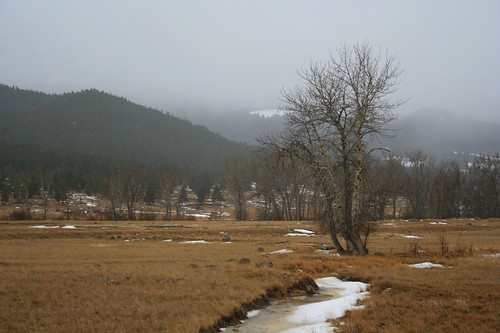
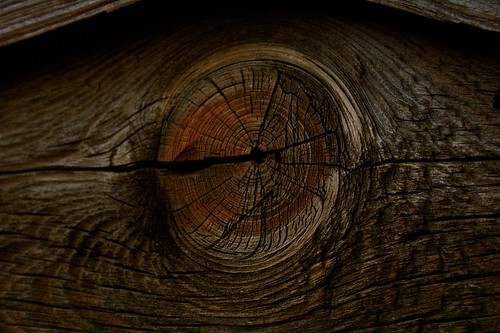
Every young farmboy (and I would say, woodworker) knows that the hardest and noblest wood has the narrowest rings, that high on the mountains and in continuing danger the most indestructible, the strongest trees grow.
Trees are sanctuaries: whoever knows how to speak to them, whoever knows how to listen to them, can learn the truth. They do not preach learning and precepts. They preach, undeterred by particulars, the ancient law of life.
A tree says: A kernel is hidden in me, a spark, a thought, I am life from eternal life. The attempt and the risk the eternal mother took with me is unique, unique the form and veins of my skin, unique the smallest play of leaves in my branches and the smallest scar on my bark. I was made to form and reveal the eternal in my smallest special detail.
A longing to wander tears my heart when I hear trees rustling in the wind at evening. If one listens to them silently for a long time, this longing reveals its kernel, its meaning ... It is a longing for home, for a memory of the mother, for new metaphors for life. It leads home. Every path leads homeward, every step is birth, every step is death, every grave is mother.
So the tree rustles in the evening, when we stand uneasy before our own thoughts. Trees have long thoughts, long-breathing and restful, just as they have longer lives that ours. They are wiser than we are, as long as we do not listen to them ...
Whoever has learned how to listen to trees no longer wants to be a tree. He wants to be nothing except what he is. That is home. That is happiness.
-- excerpts from Hermann Hesse: Wandering, translated by James Wright, © 1974 Farra, Straus & Giroux
-- Maureen
The (almost) complete excerpt is posted at my blog, Raven's Nest. Click here to read that article.



4.12.2007
You know how one thing leads to another.....?
Well, Tim and Tracy cleaned the shop! And it was a rather large new "baby" that motivated the cleanup. Check it out: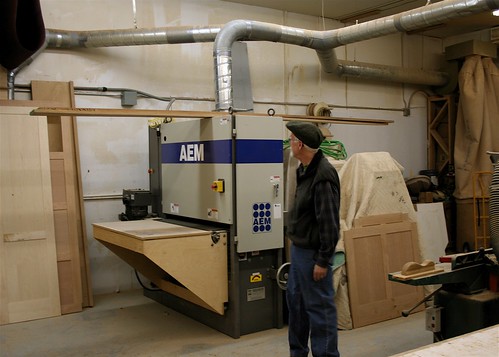
Tim is the proud new parent of an AEM wide-belt sander ... he and Doug Kralicek, of Kralicek Millworks, drove over to Pinesdale, Montana to pick it up a week ago. Huge thing!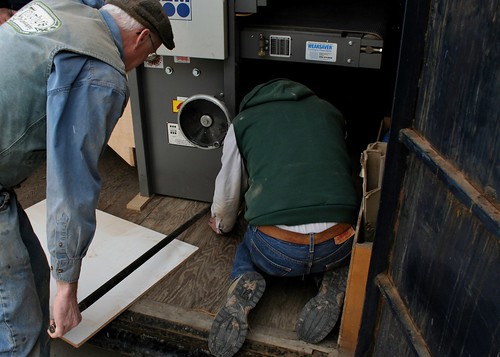
I (Maureen) had no idea how big it was until the day I dropped by to shoot some photos of the beast -- it was still in Doug's trailer and Tim, his electrician, Jim White and one of Doug's employees were scratching their heads over how to get the danged thing out of the trailer and into the shop.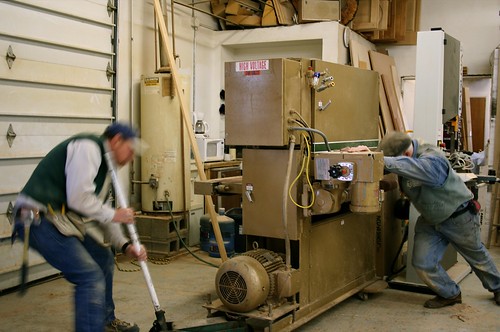 In the process of making room for the new overhead sander (and moving the older, smaller one out) Tim got all jazzed up about cleaning and organizing the shop. It was dusty. Yep. His shop was also pretty crammed with lumber, sheet goods, cabinet boxes in the midst of assembly, stuff stuff and more stuff -- and oh, did I mention the sawdust? So, Tracy and Tim spent the entire last week (Tim did the weekend too) cleaning, organizing, tossing, taking stuff to our local salvaged-building-materials store -- ReStore -- as well as to the dump.
All these years, Tim's had to store all of this supplies and materials for woodworking right in the shop. Some of that stuff he brought with him from Pocatello and hasn't looked at since the day he moved into the shop. Would ya say he might not need it anymore? The folks down at ReStore were happy to have all of his give-aways and I bet now a few days later, that stuff has found new homes all over Helena.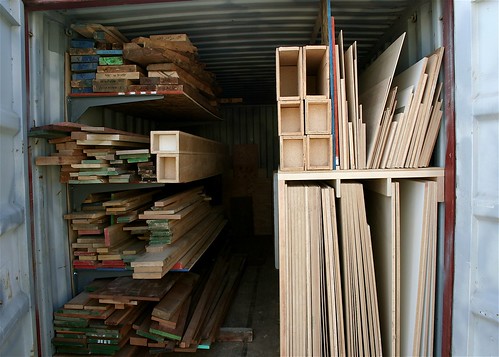 Well, one thing led to another. Or I should say, one good idea led to an even better idea. The brainstorm was to get a container to store most of the shop's wood. That cleared a huge space. And the huge space turned into even more working room in the shop.
A few days later, I was truly amazed. Tim took me over to the shop last night to show me the changes. Whoah! I hardly recognized the place! He had re-opened a double-wide doorway between the two sides of the shop, making the work flow much more efficient and comfortable.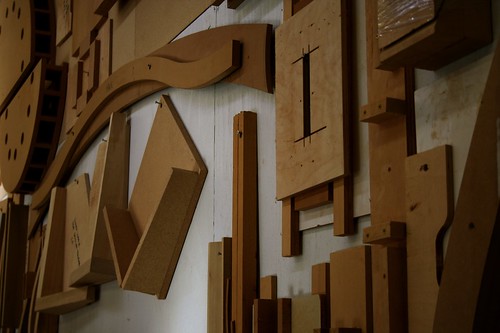 Now an entire wall is available for hanging the large collection of jigs, templates and patterns within easy reach. They divided the shop more clearly into two rooms, and both rooms are much better connected with two large doors and a large window to allow light to penetrate from the assembly room, below, into the machine room.
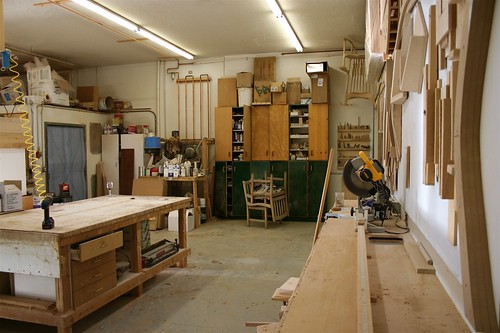
The assembly room (in both photos above) holds their workbenches, chop saw, spray booth, assembly benches, hardware storage and a cabinet for finishes.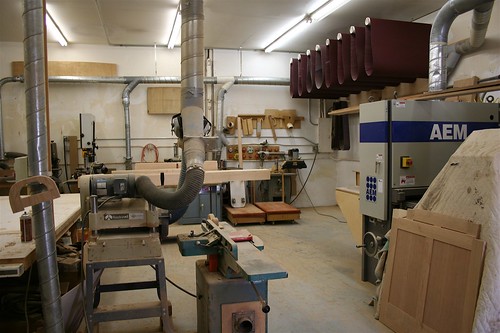 The machine room now has more room to manuever large pieces of lumber around all of the machines.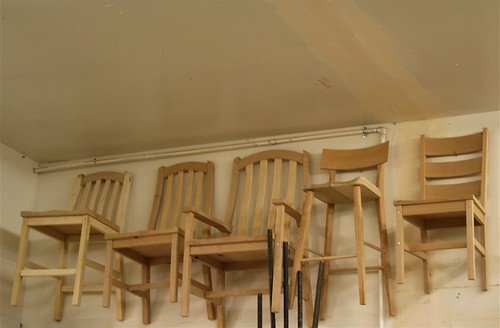
On Sunday, Tim assembled all of his chair prototypes (which had until then been mostly piles of parts.) He hung the prototypes from the ceiling. What a good idea -- plus they look cool hanging up there like wallflowers at a highschool prom.
It's going to be a much more enjoyable place to work for both guys.
Until next time,
Maureen
3.30.2007

3.28.2007
Found on the Web: What does Green Really Mean?
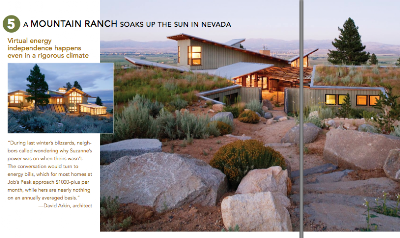
Photo from Fine HomeBuilding pdf article. Click photo to read the article
Okay, it's really happening -- green is the latest building and design industry buzzword. Heck, even the Wall Street Journal writes that the sustainable design/green-building movement has become mainstream. You know builders have jumped on the bandwagon when the National Association of Home Builders announces that it is standardizing it's voluntary green building guidelines.
Pick up any remodeling, home decorating, interior or architectural design magazine and you'll find at least one feature article on going "green." Yet how do you know, with all the green stuff coming at you from every direction, if what you are getting is really, truly green -- in the sense of environmentally friendly?
Fine Home Building (Taunton Press) has long published news about the green building movement, even before it was trendy. Tim has subscribed to Fine Home Building for many years - the publication is an excellent source of inspiration, ideas and reference articles. The latest issue of FHB includs an excellent article by editor, Scott Gibson titled, What Does Green Really Mean?
Check out Scott's article. And if you're back this way, please leave us a comment --- let us know what you think about the green building movement! Thanks for reading.
3.19.2007
8 Ways to Make Your Home Greener
Sustainability is a word that is often misunderstood. For many people, sustainability or "green" means "environmentally friendly" But it is more than reducing waste, protecting the environment and recycling. Sustainability is a process that enables all people to realize their potential and to improve their quality of life in ways that (also) protect and enhance the Earth's life support systemsOfrom the Forum for the Future) To understand sustainability we must become aware of how everything we do, everything we take, everything we make and everything we waste affects nature's balance and how our actions will ultimately affect our children and all of Earth's children.
Each choice we make has a cost that is a combination of the economic, social and environmental costs set against each choice's benefits.
In a recent study six out of ten homeowners said they would like to use sustainable, environmentally responsible design and materials in their home projects whether that means for new home construction or home remodeling. Whether they would actually use green materials depends largely on cost and looks. Here we will take a look at both of these issues and give you some ways you can -- gradually -- add the color green to your new or remodeled home.
Cost has been a deterrent to many people when they are deciding whether to spring for green building materials or stick with the old tried-and-true. Because energy costs are rising sharply with no relief in sight, at least some green building materials' costs are now closer to the non-green materials. Plus, homeowner interest in sustainable design and materials is growing rapidly -- and as interest rises, so does the demand for these products, which eventually will bring costs down further. It would take a whole other article to discuss the ROI (return on investment) concept, something we'll take up another time.
In Montana, our challenge is finding green building materials at a reasonable cost. There are added transportation costs and fewer distributors of these products in Montana. As more people ask for and demand environmentally responsible products, I hope their availability and affordability improves.
There are other ways to address the higher cost of earth-friendly materials. If you are building a new home and want to use "green" flooring such as cork, carpet made with no formaldehydes and with 100% recycled fibers, for example, it will cost lots more if you are covering 3000 square feet of floor versus if you build a smaller home in the first place and only have to install floor covering on 2000 square feet. Smaller homes are more efficient to heat as well, and the total cost of all building materials for a smaller home saves you enough that you may be able to afford to make greener choices. The look of green building materials is another issue. Many people are under the impression that green -- environmentally responsible -- design and materials, are either ugly, clunky or inelegant in appearance. This perception may be leftover from the early days of earth sheltered homes made with black painted oil drums, salvaged lumber, wine bottle walls and cedar hot tubs. On the contrary, most environmentally responsible materials and design methods today are not only beautiful, but they have a simple elegance unmatched in traditional materials. Interior designers and architects are specifying earth-friendly materials that are downright elegant and truly gorgeous. Besides, I personaloly believe salvaged lumber has a warmth and history that fits nicely with traditional or contemporary home styles.
Okay, so how can you green your home incrementally if you don't want to or can't afford to do it all at once? here are 8 suggestions:
1) If you are looking for a new home, find one within walking distance of schools, workplaces, parks and grocery stores. If you can walk to most destinations, you will use less gas. To me, that means your home is greener!
2) Build on an infill lot. Most new housing has greater environmental consequences, with development replacing open space and agricultural land. New housing also requires new infrastructure such as roads and utilities. A new home built on a vacant lot (infill) uses existing roads and utilities.
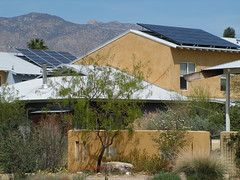
4) Design your new home to be more energy efficient and use less resources. You can do this by simply building a smaller, better-designed house. Large homes use more resources and may require more energy to heat and maintain than small to mid-sized homes. A smaller home on a smaller lot can be equally if not more satisfying to the soul, as author and architect, Sarah Susanka writes in her book, The Not So Big House.
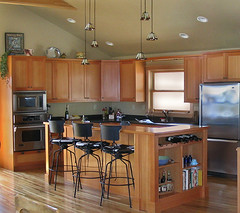
 5) Remodel to make your home greener -- just a little at a time. Whenever possible, choose environmentally preferable products such as low-gas paints, formaldehyde-free plywood, carpets made of recycled plastics, cork and linoleum flooring (both made of low-impact renewable resources,) countertops and kitchen cabinets made of recycled or earth-friendly materials and sustainably harvested wood.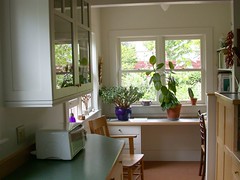
Classic Kitchen by Tim Carney
7) Landscape your home -- either new, or remodeled -- to conserve heating and cooling energy. Plant shade trees to shield your home from hot summer sun. If you plant deciduous trees on the sunny side of your house, you will have shade in summer and sunlight in winter. Evergreen trees and shrubs can also conserve energy by lifting cold winter winds up and over the house.
8) Design your home's landscape to conserve water and fossil fuels: read up on Xeriscaping methods, choose drought-tolerant plants, and substitute plant beds or hardscaping (deck, patio, pathways) for thirsty, energy-intensive lawns. Remember to use as many locally available materials as possible.